Roubo Workbench Plans PDF: A Comprehensive Guide
Roubo workbench plans, often in PDF format, detail construction from design basics to maintenance; resources include free options and paid plans like those from Lost Art Press.
These PDFs cover timber preparation, joinery, and accessory additions, offering detailed guidance for building a robust and traditional woodworking station.
Several sources offer Roubo designs, including English, Nicholson, and French variations, catering to diverse skill levels and woodworking preferences.
Roubo workbenches represent a pinnacle of woodworking bench design, originating from the 18th-century techniques detailed by André-Jacques Roubo. PDF plans allow woodworkers to recreate this historically significant and exceptionally sturdy bench.
These benches are characterized by their massive construction, primarily utilizing mortise and tenon joinery, and a substantial timber top. The design prioritizes stability and functionality, offering a robust platform for various woodworking tasks.
Modern interpretations, accessible through PDF plans, often adapt the original design for contemporary tools and materials, while retaining the core principles of strength and durability. Building a Roubo is a significant undertaking, but the result is a lifetime tool.
Historical Context of the Roubo Design
The Roubo workbench’s origins lie in the detailed illustrations and techniques documented by André-Jacques Roubo in his 18th-century encyclopedic work, L’Art du Menuisier. These plans weren’t originally “PDFs,” of course, but modern interpretations are readily available in that format.
Roubo’s designs reflected the needs of 18th-century French furniture makers, emphasizing a solid, stable platform for hand tool work. The bench’s robust construction and reliance on traditional joinery—mortise and tenon, wedges—were essential for precision.
Today’s PDF plans aim to faithfully recreate this historical design, offering woodworkers a connection to centuries of craftsmanship and a bench built to withstand generations of use.
Why Choose a Roubo Workbench?
Selecting a Roubo workbench, guided by detailed PDF plans, offers unparalleled stability and versatility for hand tool woodworking. Its massive construction minimizes flex, crucial for tasks like planing and chiseling.
Unlike lighter benches, the Roubo design excels at handling demanding work, providing a solid foundation for mortise and tenon joinery and other precision tasks. The inherent strength also allows for extensive customization.
Accessing plans in PDF format simplifies construction, offering clear diagrams and instructions to build a bench that will last a lifetime, becoming a centerpiece of any workshop.

Understanding Roubo Workbench Plans
Roubo workbench plans, frequently PDFs, require careful study of joinery details, timber lists, and dimensions for successful construction and a sturdy result.
Availability of Free Roubo Workbench Plans
Finding completely free, detailed Roubo workbench plans can be challenging, though not impossible. Online woodworking communities and forums often host user-submitted plans, but their completeness and accuracy can vary significantly. Several discussions highlight the search for “free” Roubo bench plans, indicating a demand but limited readily available resources.
These plans may require adaptation and interpretation, demanding a higher level of woodworking experience to navigate potential ambiguities. While some basic outlines exist, they often lack the comprehensive detail found in paid resources. Expect to supplement these free plans with additional research and problem-solving skills to achieve a satisfactory outcome.
Paid Roubo Workbench Plan Resources (Lost Art Press)
Lost Art Press stands out as a premier source for comprehensive Roubo workbench plans, notably through Christopher Schwarz and Will Myers’ publications. Their “Roubo Workbench: By Hand & Power” provides detailed instructions, covering everything from timber selection to final finishing.
These resources utilize both hand tool and power tool techniques, catering to diverse workshop setups. The plans emphasize building with readily available, inexpensive materials like red oak, even in its wet state. Lost Art Press offers both streaming and downloadable video content, enhancing the learning experience and providing visual guidance throughout the construction process.
Key Elements of a Roubo Workbench Plan PDF
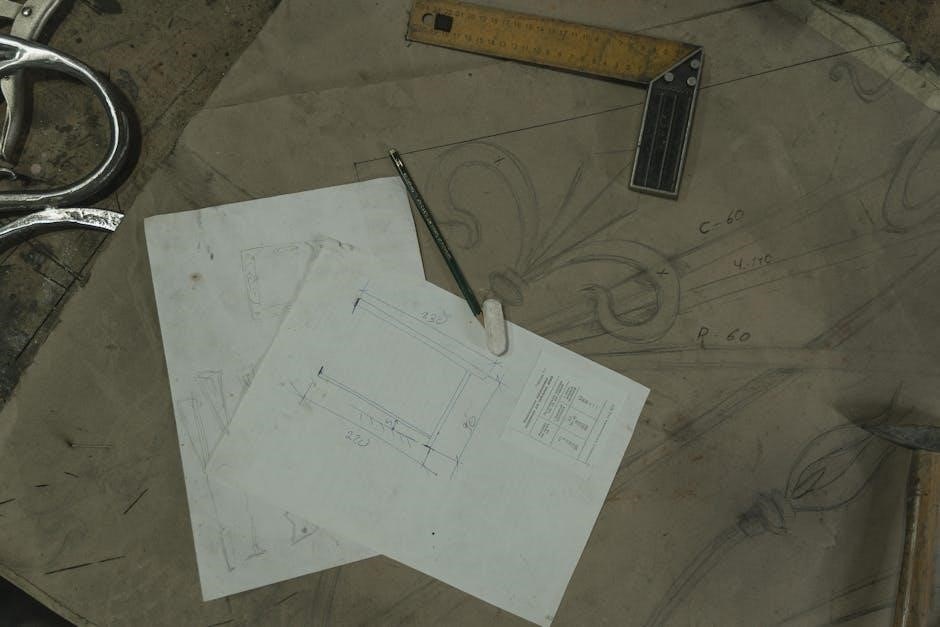
A robust Roubo workbench plan PDF typically includes detailed material lists, specifying lumber grades and hardware requirements like pegs, wedges, and fasteners. Crucially, it features precise dimensions for all components – legs, base, and the substantial top, whether constructed from a single slab or multiple boards.
Essential plans illustrate mortise and tenon joinery, wedge lock techniques, and through dovetails, the core of Roubo construction. Clear diagrams and step-by-step instructions are vital, alongside guidance on preparing timber and routing mortises. Accessory plans for vises and tool storage complete the comprehensive guide.

Materials for Roubo Workbench Construction
Roubo workbenches commonly utilize hardwoods like red oak or beech, demanding careful lumber grade selection for strength and stability during rigorous woodworking tasks.
Choosing the Right Wood (Red Oak, Beech, etc.)
Selecting wood is paramount for a durable Roubo workbench. Red oak is frequently recommended due to its affordability and availability, even in “wet” or unseasoned states, as demonstrated in some construction guides. However, beech offers superior hardness and stability, making it a premium choice for critical components.
Consider the trade-offs: oak is easier to work with initially, while beech provides long-term resilience. Other hardwoods like maple can also be suitable. The plans often suggest using less expensive wood for secondary parts, optimizing cost without sacrificing overall structural integrity. Prioritize straight grain and minimal defects for maximum strength.
Lumber Grades and Considerations
Lumber grading significantly impacts the workbench’s quality and cost. Construction-grade lumber can be utilized effectively, particularly for elements not bearing substantial weight, as detailed in some Roubo construction documents. However, for legs and the top, higher grades—like Select or Firsts—are advisable to minimize knots and imperfections.
Consider “live edge” slabs for the top, adding character, but requiring more preparation. Inspect boards for straightness and twist before purchase. Understanding lumber moisture content is crucial; working with wet wood, as some plans suggest, requires accounting for shrinkage.
Hardware Requirements (Pegs, Wedges, Fasteners)
Roubo workbenches traditionally rely heavily on wooden fasteners – pegs and wedges – for joinery, minimizing metal components. Plans often specify dimensions and wood types for these, emphasizing tight fits for secure connections. However, modern builds may incorporate screws or bolts for added strength, particularly during initial assembly or for specific features.
Consider the source of your hardware; quality pegs and wedges are essential. PDF plans may detail specific fastener lengths and diameters. Ensure compatibility with your chosen wood species to prevent splitting.

Tools Needed for Construction
Roubo workbench plans necessitate both essential hand tools and power tools for efficiency; specialty tools aid mortise and tenon joinery, crucial for a robust build.
Essential Hand Tools
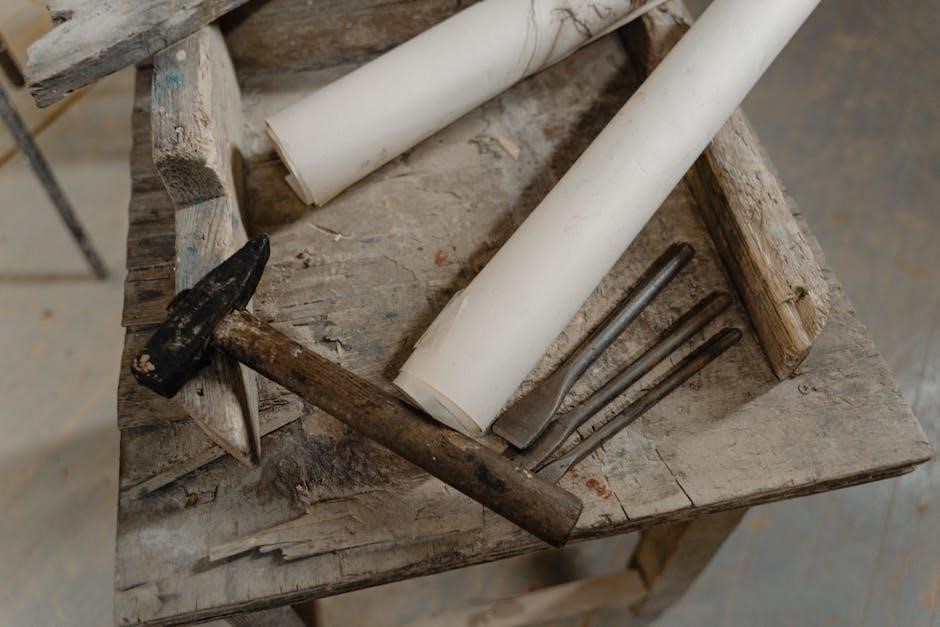
Roubo workbench plans demand a selection of fundamental hand tools for precise work. A robust set of chisels is paramount for refining mortises and tenons, the core of the design. Hand saws, including both rip and crosscut varieties, are vital for timber preparation and accurate cuts.
Essential measuring and marking tools – a marking gauge, combination square, and accurate measuring tape – ensure precision. Mallets, both wooden and rubber, are needed for driving chisels and assembling joinery. Furthermore, a smoothing plane and jack plane are crucial for surface refinement, while a brace and bits facilitate drilling peg holes and other necessary apertures.
These tools, when skillfully employed, allow for the faithful execution of Roubo designs.
Power Tools for Efficiency
While Roubo workbench plans emphasize traditional hand tool techniques, power tools can significantly accelerate construction. A bandsaw excels at resawing timber for the top and legs, saving considerable time and effort. A thickness planer and jointer ensure flat, square surfaces, crucial for stable joinery.
Drill presses streamline the creation of dog holes and other repetitive drilling tasks. Random orbital sanders expedite surface preparation, though hand-sanding remains vital for final refinement.
However, remember that power tools should complement, not replace, the precision and control offered by hand tools when executing detailed Roubo joinery.
Specialty Tools for Mortise and Tenon Joinery
Roubo workbench plans heavily feature mortise and tenon joinery, demanding specialized tools for accurate execution. A mortise chisel, properly sharpened, is essential for cleanly defining mortise walls. Marking gauges ensure precise layout for both mortises and tenons.
Shoulder planes refine tenon shoulders, guaranteeing a tight fit. A tenon saw, with its fine teeth, facilitates accurate tenon sawing. Dedicated drilling jigs aid in creating consistent and aligned mortise holes.
Investing in quality joinery tools elevates the precision and durability of your Roubo, reflecting its traditional construction principles.

Construction Stages: A Detailed Breakdown
Roubo workbench plans guide builders through timber preparation, leg and base assembly, and top construction—choosing between slab or multiple boards—for a sturdy result.
Preparing the Timber
Roubo workbench plans emphasize careful timber selection and preparation as foundational steps. Often, plans suggest utilizing readily available, inexpensive red oak, even in its “wet” state, acknowledging its affordability and suitability for robust construction.
However, proper drying is crucial to minimize wood movement later. PDF guides detail milling techniques, ensuring timbers are squared, flattened, and dimensioned accurately. This stage involves jointing and planing to achieve smooth, consistent surfaces.
The plans frequently highlight the importance of working with full-length timbers, minimizing waste and maximizing structural integrity. Careful consideration of grain orientation is also advised for optimal strength and stability.
Building the Legs and Base
Roubo workbench plans prioritize a massively strong base, typically constructed using mortise and tenon joinery – a hallmark of the design. PDF guides detail precise dimensions and angles for leg splay, contributing to stability.
Construction often involves creating robust legs from thick timber, connected by stretchers forming a rigid frame. Wedge lock joinery is frequently incorporated to further secure these connections, resisting racking forces.
Plans emphasize accurate fitting of joints, ensuring a flush and square base. Some designs feature additional bracing for enhanced stability, particularly for larger workbenches.
Constructing the Top (Slab vs. Multiple Boards)
Roubo workbench plans offer options for constructing the top – either from a single, substantial slab or by joining multiple boards. PDF guides detail both approaches, outlining the pros and cons of each.
A slab top, often red oak, requires less joinery but demands a wider, thicker piece of timber. Multiple board tops necessitate careful edge-joining, utilizing techniques like tongue and groove or breadboard ends to manage wood movement.
Plans emphasize flattening the top surface, crucial for accurate work. Considerations include wood selection, minimizing warping, and achieving a perfectly level work surface.
Joinery Techniques
Roubo workbench plans PDF guides emphasize mortise and tenon joints as core to the design, alongside wedge lock joinery and through dovetails for exceptional strength.
Mortise and Tenon Joints – The Core of Roubo Design
Roubo workbench plans PDF resources consistently highlight mortise and tenon joinery as fundamentally crucial to the workbench’s structural integrity. These joints, meticulously detailed in the plans, provide unparalleled strength and rigidity, essential for withstanding the stresses of woodworking.
The plans often demonstrate techniques for accurately laying out and executing these joints, utilizing both hand tools and, optionally, power tools for increased efficiency. Emphasis is placed on achieving a tight, secure fit, often incorporating wedges for enhanced locking and long-term stability.
Understanding the nuances of mortise and tenon construction, as presented in these PDF guides, is paramount for successfully building a durable and reliable Roubo workbench.
Wedge Lock Joinery
Roubo workbench plans PDF documentation frequently showcases wedge lock joinery as a key element, particularly in leg and base construction. This technique, integral to the Roubo design, utilizes precisely fitted wedges to create an exceptionally strong and self-tightening connection.
The PDF guides detail the angles and dimensions required for accurate wedge creation and installation, ensuring a secure and lasting bond. Wedge lock joinery effectively addresses wood movement, maintaining joint tightness even with seasonal changes.
Mastering this method, as illustrated in the plans, is vital for achieving the renowned stability and longevity characteristic of a traditionally built Roubo workbench.
Through Dovetails for Added Strength
Roubo workbench plans PDF resources often incorporate through dovetails to significantly enhance structural integrity, particularly in connecting the base rails to the legs. These visually striking joints provide exceptional resistance to racking forces, crucial for a stable workbench.
Detailed PDF instructions guide users through the precise layout, cutting, and fitting of dovetails, emphasizing the importance of tight-fitting tails and pins. The plans illustrate various methods for achieving clean and accurate dovetail joints, even for those with limited experience.
Employing through dovetails, as depicted in the Roubo designs, ensures a robust and enduring connection, contributing to the workbench’s overall longevity.

Workbench Accessories and Modifications
Roubo workbench plans PDF often include options for adding vises, tool storage, and dog holes, enhancing functionality.
Customization allows woodworkers to tailor the bench to their specific needs and workflow preferences.
Adding a Vise (Tail Vise, Face Vise)
Roubo workbench plans PDF frequently detail the integration of both tail and face vises, crucial for securing workpieces during various operations. Tail vises, mounted to the end of the bench, excel at holding long stock, while face vises, positioned on the front edge, are ideal for clamping boards flush.
PDFs often provide dimensions and guidance for mortising and installing these vises, ensuring a secure and functional fit. Considerations include wood selection for the vise components and the precise placement for optimal clamping pressure. Some plans even offer options for building your own vises, offering a cost-effective alternative to purchasing pre-made units.
Proper vise installation significantly enhances the versatility of the Roubo workbench.
Tool Storage Solutions
Roubo workbench plans PDF often incorporate integrated tool storage, recognizing the need for organized access during woodworking. Common solutions detailed in these plans include tool wells beneath the benchtop, designed to hold frequently used hand tools, and dovetailed trays for smaller items like chisels and marking gauges.
Some plans showcase the addition of drawers, either full-width or narrower configurations, providing concealed storage for larger tools or projects in progress. The PDFs frequently offer dimensions and joinery techniques for constructing these storage elements, ensuring seamless integration with the workbench’s structure.
Effective storage maximizes workspace efficiency.
Dog Holes and Bench Dogs
Roubo workbench plans PDF consistently emphasize the inclusion of dog holes, a defining feature for securing workpieces. These plans detail precise spacing and drilling techniques for creating a grid of holes across the workbench top, accommodating various clamping scenarios.
The PDFs illustrate the use of bench dogs – typically wooden or metal pegs – inserted into these holes to provide a firm hold when combined with clamps. Variations in dog designs are often presented, alongside instructions for crafting custom dogs.
Dog holes enhance versatility, enabling efficient workholding for diverse woodworking tasks.

Troubleshooting Common Construction Issues
Roubo workbench plans PDF often address wood movement, joinery problems, and stability concerns, offering solutions for common construction challenges during the build process.
Dealing with Wood Movement
Roubo workbench plans PDF resources frequently emphasize understanding wood movement, a critical aspect of successful construction. Wood expands and contracts with humidity changes, potentially causing issues like cracks or joint failure.
Effective plans detail techniques to accommodate this, such as using appropriately sized tenons, allowing for seasonal expansion in the top, and employing breadboard ends.
Properly designed joinery, as outlined in detailed PDFs, minimizes stress and prevents racking. Understanding grain orientation and selecting stable lumber are also crucial, ensuring a durable and long-lasting workbench.
Addressing Joinery Problems
Roubo workbench plans PDF guides often dedicate sections to troubleshooting common joinery issues. Mortise and tenon joints, central to the Roubo design, require precision; PDFs detail correcting misaligned or loose fits.
Wedge lock joinery, if problematic, may necessitate re-cutting wedges or adjusting mortise dimensions. Detailed plans illustrate proper wedge angles and fitting techniques.
Through dovetails, used for added strength, can be challenging; resources offer solutions for tight fits and preventing splitting. Careful study of the PDF diagrams is essential for successful execution.
Ensuring Stability and Levelness
Roubo workbench plans PDF resources emphasize achieving a rock-solid, level work surface. PDFs detail methods for checking leg squareness during construction, crucial for overall stability.
Addressing wood movement is key; plans often suggest techniques like slotted tenons or breadboard ends to accommodate seasonal changes.
Leveling the top is addressed through careful planing or shimming. Detailed diagrams illustrate proper bracing and leg attachment methods to prevent racking. A stable Roubo bench is paramount for accurate woodworking.

Roubo vs. Other Workbench Designs
Roubo workbench plans PDF resources often compare designs to English and Nicholson benches, highlighting the Roubo’s massive construction and superior stability for demanding tasks.
Comparing Roubo to English and Nicholson Workbenches
Roubo workbench plans PDF frequently showcase comparisons to other classic designs. English workbenches typically feature a simpler, lighter build, prioritizing portability and affordability, while Nicholson benches often incorporate knockdown designs for easy storage.
However, the Roubo distinguishes itself with its substantial mass and robust mortise-and-tenon joinery, offering unparalleled stability for heavy work. PDF plans reveal the Roubo’s thicker legs and larger top surface area contribute to its rigidity.
While English and Nicholson benches suit smaller spaces and lighter tasks, the Roubo excels in demanding applications, making it a preferred choice for serious woodworkers.
Advantages and Disadvantages of Each Style
Roubo workbench plans PDF highlight that Roubo benches offer exceptional stability and strength, ideal for demanding tasks, but require significant material and construction time. English workbenches, detailed in some PDFs, are lightweight and portable, yet lack the Roubo’s rigidity.
Nicholson designs, often found as knockdown plans, prioritize storage convenience, but may compromise on overall robustness. The Roubo’s mass can be a disadvantage in smaller shops, while English benches might struggle with heavy chopping.
Ultimately, the best choice, as indicated by PDF comparisons, depends on individual needs, space constraints, and the type of woodworking pursued.
Choosing the Right Workbench for Your Needs
Selecting the ideal workbench, guided by Roubo workbench plans PDF resources, hinges on your woodworking style and available space. If heavy timber framing is your focus, a robust Roubo is paramount, despite its size. For portability and lighter tasks, an English or knockdown Nicholson, detailed in some PDFs, proves more practical.
Consider your budget; Roubo construction demands more expensive materials. Assess your skill level – Roubo joinery is complex. PDF plans often showcase variations, allowing customization.
Prioritize features like vise placement and storage based on your workflow, ensuring the chosen design complements your craft.
Maintenance and Care
Roubo workbench plans PDF resources emphasize protecting the wood finish with regular inspections and repairs to maintain optimal condition for years of use.
Protecting the Wood Finish
Roubo workbench plans PDF guides consistently highlight the importance of safeguarding the wood finish, as it directly impacts the workbench’s longevity and functionality. Applying a durable finish, like oil or varnish, shields against moisture, spills, and wear from daily use.
Regular cleaning with a mild soap solution and occasional re-application of finish are crucial. Avoid harsh chemicals that can damage the wood. Consider a beeswax polish for added protection and a subtle sheen. Consistent care, as detailed in many Roubo plans, ensures your workbench remains a reliable and beautiful tool for generations.
Regular Inspections and Repairs
Roubo workbench plans PDF resources emphasize proactive maintenance through regular inspections. Periodically check for loose joints, particularly mortise and tenon connections, and tighten as needed. Examine the top for any developing cracks or warping, addressing them promptly to prevent further damage.
Inspect vises and dog holes for wear, and repair or replace components as necessary. Addressing minor issues immediately, guided by the principles within Roubo plans, prevents them from escalating into major repairs. Consistent upkeep ensures your workbench remains stable, safe, and a pleasure to use for years to come.
Keeping Your Workbench in Optimal Condition
Roubo workbench plans PDF guides highlight the importance of protecting the wood finish to maintain optimal condition. Regularly apply a suitable wax or oil finish to prevent moisture absorption and protect against wear. Clean the surface frequently, removing sawdust and debris to avoid buildup and potential damage.
Periodically assess and address any developing issues, referencing your Roubo plans for guidance. Proper care, informed by detailed construction knowledge, ensures longevity and preserves the workbench’s functionality. A well-maintained Roubo bench remains a reliable centerpiece for woodworking endeavors.